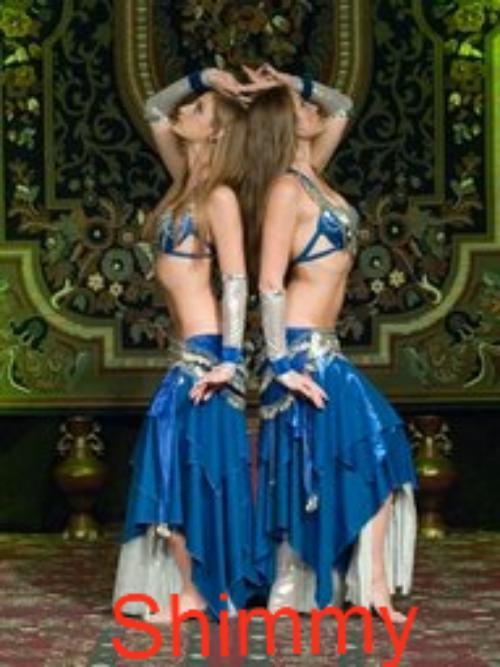
A shimmy is a dance move in which the body is held still, except for the shoulders, which are alternated back and forth. When the right shoulder goes back, the left one comes forward. It may help to hold the arms out slightly bent at theelbow, and when the shoulders are moved, keep the hands in the same position. In the late 1910s others were also attributed as being the "inventor" of the shimmy, including Bee Palmer.Mae West, in her autobiography Goodness Had Nothing to Do with It, claimed to have retitled the "Shimmy-Shawobble" as the Shimmy herself, after seeing the moves in some black nightclubs.The move is also known under different names in various folk dances, in Gypsy dances.
The shimmy is also a class of belly dance moves. Depending on the desired effect, style, teacher, and country of origin of the particular dance, a shimmy might be executed differently, but altogether, the shimmy will manifest as a fast shaking or shuddering movement that can be rhythmic or arrhythmic. The movement may be localized, such as in the hips, shoulder, chest, etc., or the move might be loose and general, reverberating through the entire body. Shimmies in belly dance can also have orientation, such as an up/down movement or a twisting movement of the hips.
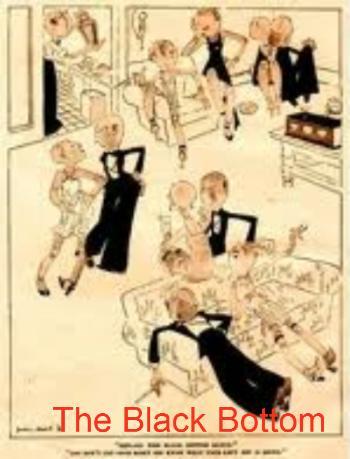
The dance originated in New Orleans in the 1900s (decade). The theatrical show Dinah brought the Black Bottom dance to New York in 1924, and the George White's Scandals featured it at the Apollo Theater in Harlem 1926 through 1927 where it was introduced by dancer Ann Pennington. Jelly Roll Morton, jazz player and composer, wrote the tune "Black Bottom Stomp" with its name referring to Detroit's Black Bottom area. The dance became a sensation and ended up overtaking the popularity of the Charleston, eventually becoming the number one social dance.
The dance was well known among semi-rural blacks across the South. A similar dance with many variations had been commonly used in tent show performances, and "Bradford and Jeanette" had used it as a finale. The dance was featured in the Harlem show Dinah in 1924, and then "The Scandals of 1926," whereupon it became a national craze.
The rhythm of the Black Bottom is based on the Charleston, which is a dance named for the harbor city of Charleston, South Carolina. The rhythm was popularized in mainstream dance music in the United States by a 1923 tune called "The Charleston" by composer/pianist James P. Johnson which originated in the Broadway show Runnin' Wild and became one of the most popular hits of the decade.
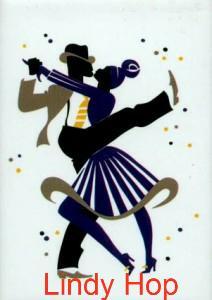
The Lindy Hop is an American dance that evolved in Harlem, New York City in the 1920s and 1930s and originally evolved with the jazz music of that time. Lindy was a fusion of many dances that preceded it or were popular during its development but is mainly based on jazz, tap, breakaway and Charleston. It is frequently described as a jazz dance and is a member of the swing dance family.
In its development, the Lindy Hop combined elements of both partnered and solo dancing by using the movements and improvisation of black dances along with the formal eight-count structure of European partner dances. This is most clearly illustrated in the Lindy's basic step, the swingout. In this step's open position, each dancer is generally connected hand-to-hand; in its closed position, men and women are connected as though in an embrace.
