[Jazz music] Famous Musician --- Louis Armstrong
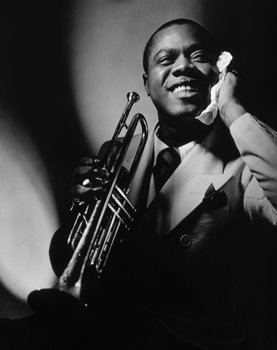 | ---Louis Armstrong |
Louis Armstrong is regarded as the most influential musician in jazz history.
He was born in poverty in New Orleans in 1901. His father was a workman, and his mother was a maid and a prostitute. His father abandoned the family soon after Louis’ birth.
In the third grade, Armstrong dropped out of school. He spent his time roaming the red light district of Storyville with other boys. His delinquency eventually landed him in the Colored Waifs Home around age 12.
This event was more of a blessing than a curse, as he was kept out of trouble and introduced to music. It was in the institution's band that he learned to play several instruments. He eventually settled on the cornet.
As a teenager he set his heart upon becoming a musician, and he worked odd jobs while playing in a variety of bands.
Armstrong’s talent quickly became recognized and he got a job as a professional musician on a steamboat. The job paid fifty dollars a week—the most money he had ever earned.
In 1924, famous bandleader, Flecther Henderson, asked Armstrong to join his band in New York. He grew to mesmerize and captivate New York audiences with his musical style. He quickly became a major figure in the New York jazz scene.
After spending one year in New York, Armstrong returned to Chicago. In 1926, he made his first recording under his own name; with a band he named The Hot Five.
Armstrong is also known for creating the technique known as “scat singing.” This singing in nonsense syllables and improvised sound became a trend amongst jazz musicians in that time.
It was not long before Armstrong reached international fame. When he moved back to New York in 1929, he performed on Broadway, played in movies, and recorded much more music. He continued to bring joy and inspiration to mass audiences through his music until his death in 1971.
Louis Armstrong “What a wonderful world” | Louis Armstrong “Mack the Knife” |
[Jazz music] Famous Musician--- Billie Holiday (Lady Day)
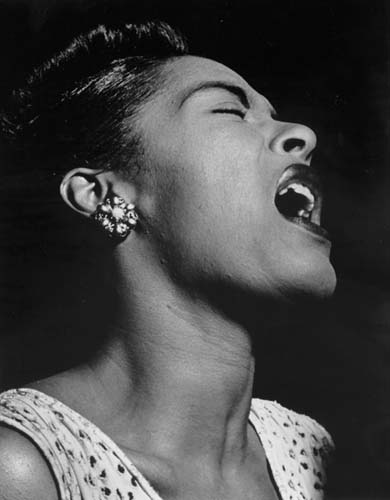 | “I never hurt nobody but myself and that's nobody business but my own.” ---Billie Holiday |
Eleanora Harris (a.k.a. Billie "Lady Day" Holiday) was born in Philadelphia in 1915. She had a hard childhood—her father abandoned the family and Billie was cared for by abusive relatives. She was raped at 11 years old, and spent her entire childhood in poverty.
In 1929, at the young age of 14, Holiday moved to New York where she worked as a maid and as a teenage prostitute.
In 1930, she also began to sing in bars and restaurants to avoid eviction. At first, singing was a way to make money for Holiday—a means for survival. However, it soon became a passion for her, one that was readily received by audiences.
Her lucky break came while singing in front of the well-connected record producer and talent spotter John Hammond Jr. He arranged for her to record a couple of titles with Benny Goodman in 1933.
During 1935-42 she made some of the most memorable recordings of her career. These jazz-oriented performances were joined by the most prominent swing musicians of the time. Holiday intended to combine Louis Armstrong's swing and Bessie Smith's sound in order to create her own original technique.
In 1939, Holiday made music history by recording "Strange Fruit," a strong anti-racism song that became a permanent part of her repertoire.
After recording a string of popular titles, Holiday became addicted to heroine and spent much of 1947 in jail. Nonetheless, her celebrity status never decreased, and she was just as popular as ever. However, her heroine use and excessive drinking continued well into the 1950’s.
Ending her life in the same tragic way it began, Billie Holiday was placed under arrest for drug use on her deathbed. She died on July 17, 1959, at the age of 44 in New York.
Billie Holiday “Summertime” | Billie Holiday “Strange Fruit” |
[Jazz music] Famous Musician--- Duke Ellington
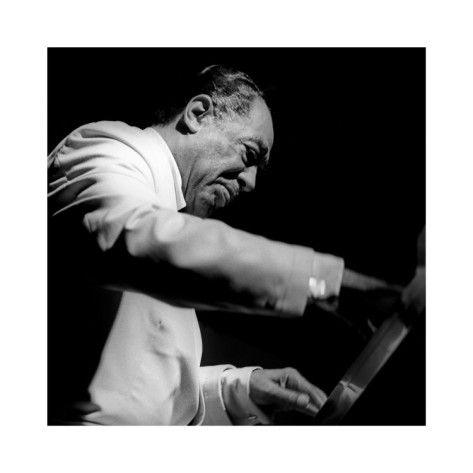 | “By and large, jazz has always been like the kind of a man you wouldn't want your daughter to associate with.” --- Duke Ellington |
“If jazz means anything,” Edward Kennedy Ellington once said, “it is freedom of expression.” No one in the history of jazz expressed himself more freely –– or with more variety or swing or sophistication.
He was a masterful pianist but his real instrument was the orchestra he led for half a century. More consistently than anyone else in jazz history, Ellington showed how great music could simultaneously be shaped by the composer and created on the spot by the players. Each of his almost 2,000 compositions – love songs and dance tunes, ballet and film scores, musical portraits and tone poems, orchestral suites and choral works and more –– was crafted to bring out the best in one or another of the extraordinary individuals who traveled the road with him.
Ellington hated what he called “categories,” and refused to conform to anyone else’s notion of what he should be doing.
As a result he managed to encompass in his music not only what he once called “Negro feeling put to rhythm and tune” but the rhythm and feeling of his whole country and much of the wider world, as well.
“My attitude is never to be satisfied, never enough, never.”
Duke Ellington “ Take The "A" Train” | Duke Ellington “It Don’t Mean a Thing” |
